Red-tailed Hawks
(Buteo jamaicensis)
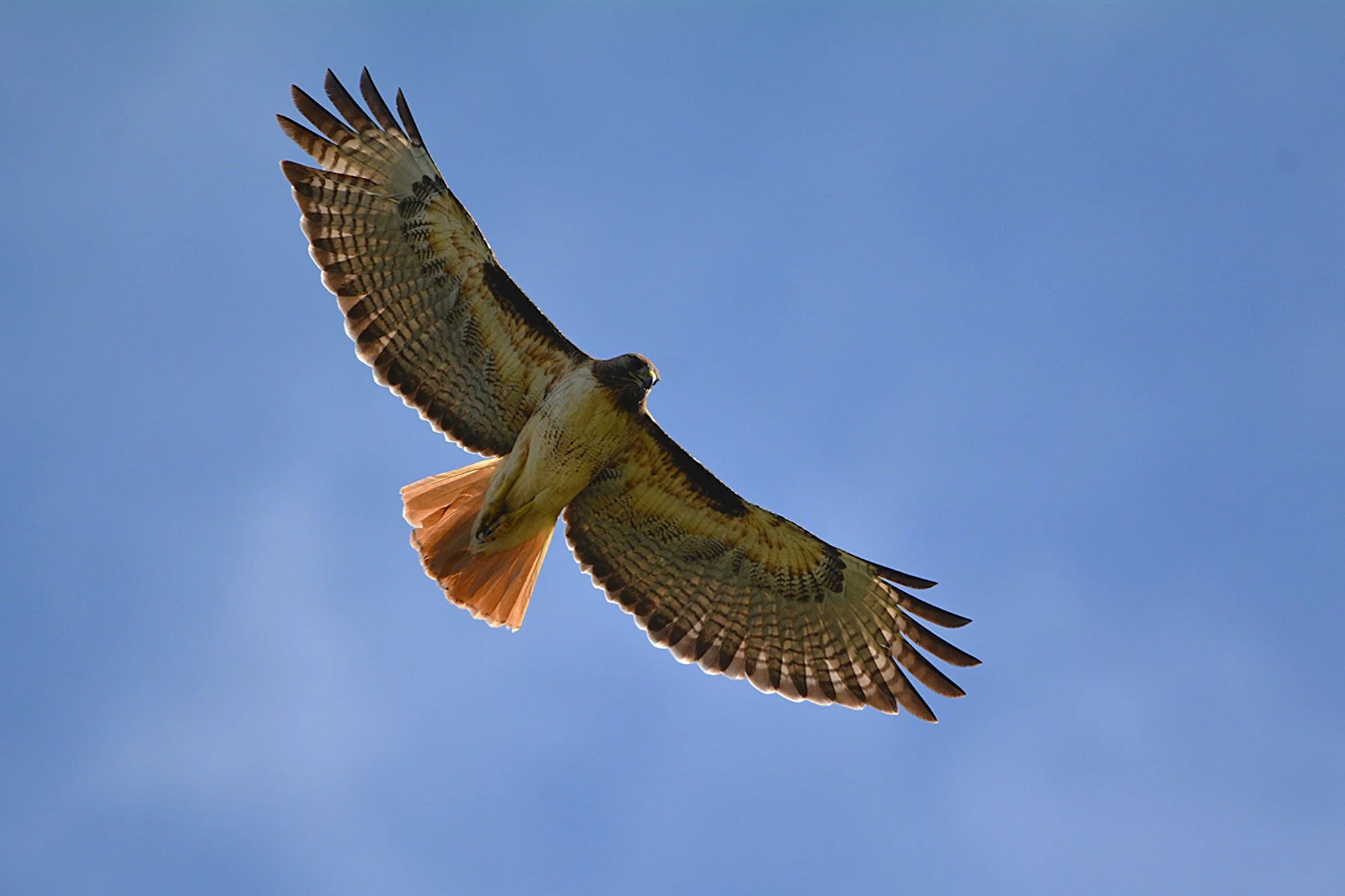
Photo credit: Pete Bloom (all rights reserved)

Red-tailed hawk with a rattlesnake - oops!
Photo Credit: Nicollet Overby (all rights reserved)
The most commonly observed large raptor in the United States.
Can nest in almost any habitat where an adequate structure exists to support a nest (i.e. trees, power towers, cliffs, etc.).
Home ranges are typically about 1 – 1 ½ square miles within coastal California areas.
Typically lays eggs from late February through late March. Incubation lasts about 30 days with young fledging at 6.5 weeks of age.
Young hawks may disperse up to 1,000 miles from the nest site, however most return to breed within 20 miles of where they fledge.
The oldest known Red-tailed Hawk in southern California survived 28 years.
Adult Red-tailed Hawks have a wingspan of approximately 3½ - 4½ feet, and weigh approximately 2 - 4 lbs. Like many raptors, females are larger than males.
Prey for Red-tailed Hawks in southern California usually consists of Audubon's cottontail, California ground squirrel, dusky-footed woodrat, Botta’s pocket gopher and gopher snake.
Many people are surprised to learn that the shrill, raucous scream they hear in movies when an eagle is onscreen is actually the call of a Red-tailed Hawk!
RESEARCH
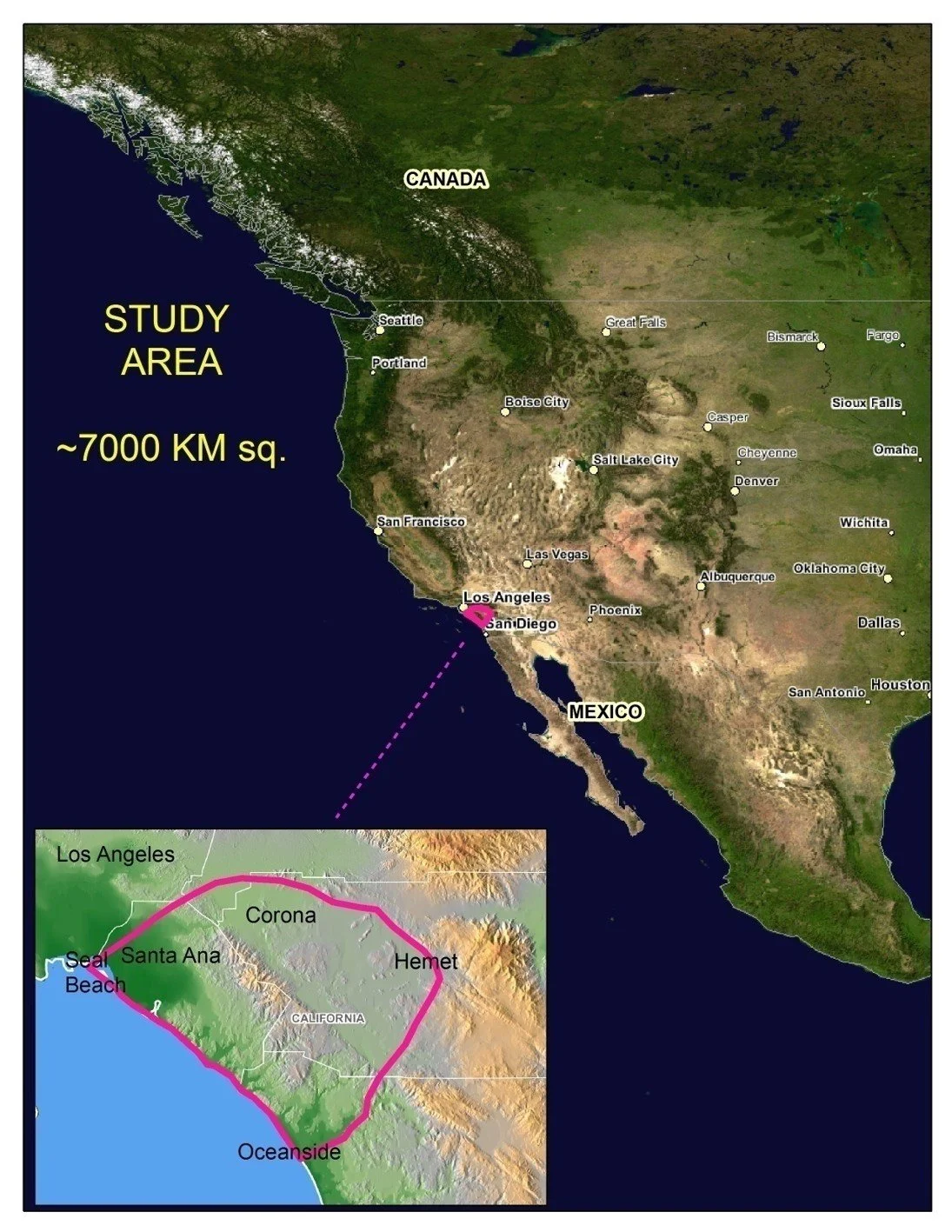
A significant majority of fledgling Red-tailed hawks from southwestern California migrate north.
Migration is initiated during the summer.
They travel substantial distances (Range = 380–1400 km).
They generally spend the summer in the Central Valley or in the Great Basin Desert.
Migration occurs annually four times over four years, then they become a resident.


RESULTS
Northbound Migration began as early as 25 June and as late as 3 August.
Second year Northbound Migration may begin as early as 2 May.
Southbound Migration began as early as 3 August and as late as 24 October.
One non-breeding female made four complete migrations in a four year period: twice to Idaho and twice to Oregon.
Another female, also over a four year period, acquired a mate in her second calendar year of life and made two complete migrations and became resident upon acquiring a mate.
Recaptures:
All (n = 96)
91 (95%) were philopatric (<10 terr.)
78 (81%) were strongly philopatric (<5 terr.)
Females (n = 36)
33 (92%) were philopatric
26 (72%) were strongly philopatric
Males (n = 60)
58 (93%) were philopatric
52 (87%) were strongly philopatric
Encounters:
(n = 48)
37 (77%) were philopatric (natal or adjacent 10-min Block)
FURTHER READING - ADDITIONAL BLOOM RESEARCH:
Briggs, C. W., Hull, A. C., Hull, J. M., Harley, J. A., Bloom, P. H., Rosenfield, R. N., & Fish, A. M. (2020). Natal dispersal distance and population origins of migrant red-tailed hawks and Cooper's hawks. Journal of Raptor Research, 54(1), 47-56.
McCrary, M. D., Bloom, P. H., Porter, S., & Sernka, K. J. (2019). Facultative migration: New insight from a raptor. Journal of Raptor Research, 53(1), 84-90.